We tried beachcombing on the river Thames in London. We had a very knowledgeable archaeologist, Fiona, that led us down to the water, telling us tidbits of rules and information, historical narratives of London back when as well as her very own stories being an archaeologist. I found someone else's blog of their experience with Fiona.
Beachcombing is NOT mudlarking (Fiona said this several times). The difference between beachcombing and mudlarking are pretty simple. Beachcombing is just as it sounds, combing the surface of the beach, no digging or disturbing the beach, such as nudging with your foot, for treasures. Beachcombing is acceptable and free; however, if you plan to go mudlarking, you need a license. Mudlarking, although the common term that most people use for scouring the shore fronts, you could legally dig to a certain depth. I can't remember exactly, maybe 4 inches (centimeters?).
The Thames has some kind of bacteria in the water which is just gross and you don't want to contract it, so wear gloves and don't touch your mouth and face, bring hand-sanitizer or wipes ( I would probably recommend this for anywhere, just in case). Bring a sturdy plastic baggies to hold your finds. I used a Ziploc sandwich bag which sufficed my needs. Also, wear sturdy shoes, such as wellies, to keep your feet dry should the tide come in and give you better grip so you don't fall. Fiona and several others wore trainers (tennis shoes as we call them in the states).
Hopefully it goes without saying that, in order to beachcomb, you have to wait for low-tide, when the beach is exposed. As for times during the year, I have heard conflicting information that you can just go down any time and other information stating you have to wait until the 2 public beach days during the year or by invitation from the Crown (this may apply on to mudlarking on the Thames). Now for beginners, I'd suggest doing the London Walks tour with Fiona first, or a few times. It costs £10, so it's a pretty cheap adventure.
Fiona took us down on the South side, near Shakespeare's Globe Theatre where most of the peasants and "poorer" people lived. The opposite side, near Tower Bridge is supposedly the "rich" side. On our beachcombing expedition, we found pieces of coal, flint, crockery, bones, teeth, nails, glass, roof tiles, clay pipes, and more. After combing the beach for about 15- 20 minutes, Fiona had us gather around so she could tell us just what we had found, then set us loose again. The tour was set for about 2 hours which seems like quite a while, but time sure does fly when you're having fun!
Another thing to keep in mind is that if you find something valuable, it must be turned over for documentation and recording. So, if you're on your own, and you find something you think is valuable, you need to register it (which is why I recommend a London Walks tour). Here is an accumulation of some of our finds. To each their own. What one person finds interesting, another may not.
For some more rules, click here.
For some of the best places to go beachcombing in the UK
Best wishes on your adventure!
Wednesday, 16 March 2016
Monday, 14 March 2016
Scotland's Real Braveheart
We made the trip back up to Scotland with the in-laws this past week and had a great time. We took a bus tour (with Micheal our guide) to Dumferline Abbey, Bannocockburn battle site, Stirling Castle, and Rosslyn Chapel which was really entertaining, informative, and steeped with conspiracy.
William Wallace is famous for that movie, you know, the one with Mel Gibson, Braveheart... Well, William Wallace was an actual figure in Scotland during the end of the 1200s. He is known for defeating the English in the Battle of Stirling Bridge against a much larger English army, rebelling against Edward I of England that imposed his authority on the Scots. He led successful raids along the English/Scottish borders that Edward sent more armies after Wallace. He retreated to Scotland where the English army defeated the Scots at Falkirk. William Wallace got away, but eventually he was captured, accused of treason, hanged, and quartered.
William Wallace became guardian of Scotland, a title shared with Robert the Bruce and John Comyn. The movie Braveheart would have you believe that William Wallace was/is known to the Scots as 'Braveheart'; however, that title is held for Bruce.
Unlike William Wallace, Robert the Bruce was a nobleman with ties to the Scottish royal family. Unlike Wallace, Bruce supported Edward I, that is until he didn't and turned his support to William Wallace. Bruce was excommunicated by the church and labeled an outlaw by Edward I after he stabbed John Comyn in Dumfries Church which meant he could not be recognized as a king. Bruce still declared himself king and was backed by the Scots and a petition was sent to the Pope to acknowledge Robert the Bruce as the rightful King of Scotland.
The Pope responded that Bruce would be recognized as King should he help fight in the Holy Lands. Robert the Bruce would not make it the Holy Lands, but instructed someone to go in place and to take his heart so that he'd be there in spirit. His heart only got as far as Spain when it is said that before dying, his replacement threw Robert the Bruce's heart at the Moors. The Moors, impressed with such a heart, sent it back to Scotland where it resides at Melrose Abbey, hence the name Braveheart. Robert the Bruce's body, however, resides at Dumferline Abbey.
William Wallace's mother also rests at Dumferline Abbey. William Wallace could not be recognized by the church; however, a thorn tree was planted next to his mother's grave as Wallace was known as a thorn in King Edward's side.
After Edward I died, his son Edward II carried on his father's belief to rule over the Scots. Edward II and his army met Robert Bruce at Bannocockburn in the English's attempts to capture Stirling Castle, the gateway to the highlands. The English army greatly outnumbered Bruce's army, however, Bruce had been trained as an English knight and knew how the English army would operate. One Englishman in particular, Sir Henry de Bohun, thought he could strike down Bruce and charged him. Bruce, in turn, slew Sir Henry in a single swoop of his ax. The Scots pushed back the English army backwards towards a boggy river by forming schiltrons. The English fled back, many drowning in the river. It is said the number of bodies in the river made it possible for others to cross the river by stepping on the dead.
Stirling Castle is known as the key to Scotland for its strategic location between the Lowlands and the Higlands, a stronghold during the Independence wars, and home to many royals such as Mary Queen of Scots.
Our last stop was Rosslyn Chapel, made famous by Dan Brown's Da Vinci Code. Rosslyn Chapel was first founded in 1446. The chapel took some 40 years to build and finish all the intricate stone work. It is said that a Master artist finished on of the columns in the chapel and went off to get inspired, leaving his apprentice behind. The apprentice has vision, and when the master returned, he was outraged that the apprentice had carved the column across from the master's that the master killed the apprentice. The head of the apprentice was carved in the corner of Rosslyn Chapel looking across to the column of the master with a star above his head. The master's head is also carved into Rosslyn Chapel to forever look at the masterpiece that is his apprentice's work.
There is also interesting carving depicting the seven sins and the seven ways to get to heaven. There is one that is both depicted on sides of the carving. Unfortunately you cannot take pictures inside nor did we find the Holy Grail.
Other places we visited this past week with the in-laws:
Warwick Castle
Angelsey Abbey
Beachcoming
Also, see read through my 1st trip in Edinburgh here. And if you're looking for that special reminder/souvenir from you trip to Scotland, check out this link of Scottish products to bring home.
Tuesday, 26 January 2016
♪♪ Paris holds the key to her heart ♪♪
Trip to Paris, anyone? Oui!
The other week, my friends and I were trying to decided where to go for our next adventure after Birmingham. It was pretty unanimous that Paris was to be our destination. In a matter of hours, we had booked ourselves a trip to Paris!
We set out on our journey, after readying the car as we were driving to Paris. I ask you, how many women does it take to air up tires, figure out radiator fluids and the like? Just so you know, it takes 5! I greatly enjoy travelling with my group of friends as we never seem to have a dull moment, and I can say for a fact that others find us greatly amusing, or at least the French seemed to!
To the Port
We drove down to the car ferry in Dover full of excitement (and non stop chattering); not even the miserable rain could dampen our spirits! Our ferry wasn't scheduled to leave until the evening, but we decided to give ourselves extra time to visit the White Cliffs of Dover. For the most part, the rain had stopped by the time we arrived; however, a heavy fog settled in which meant you could not see very far. In fact, it was quite foggy that one didn't even realize that you were being overtaken (passed) by another person until they appeared next to you. This happened to one of my friends. A poor, innocent walker was trying to get around us, and my friend nearly jumped out of her skin because he surprised her as she did not see him until he was striding past her! We encountered the same man later on our hike and he kindly took a group photo of us on our way back to the car.
We returned to the car a bunch of drowned rats, covered in mud! The wet, chalky ground had made it somewhat challenging to walk as mud caked to the bottoms of our shoes. Luckily, we were able to somewhat clean ourselves before heading to the docks to continue our journey.
Getting the car onto the ferry wasn't too difficult, despite the lack of signs indicating where to go..
It was a 2 hour ferry ride to the French port so we settled down with a cup of tea/coffee, depending on preference, and relaxed. The water was somewhat choppy and you could feel the waves hitting the boat, but it wasn't bad. Once we reached the other side, we disembarked and set off for Paris!
Driving in Paris
In the UK, one drives on the left side of the road and the speed/distance is in miles. On mainland Europe, one drives on the right side of the road and the speed/distance is in kilometers. There are also other specific requirements for driving in France. We had to have a road kit that included reflective vests, road triangle, and other stuff as well as a GB sticker, breathalyzers, and headlight stickers to redirect the beams from the headlight since we were in a British spec car. Again, I ask, how many women does it take to put on headlight stickers? Well the answer is 5 plus a French guy that had been watching our attempts to figure out the directions (which in our defense, there was over 100 steps)! I'm positive our headlight stickers did nothing to correct the beams as I'm sure they were more than likely not on right; however, we went on our way, destination Paris.
It was about a 3 hour drive from the French port to Paris which involved a toll (a pretty expensive on at that), but we successfully navigated the situation with little confusion (?). We finally reached the city of Paris close to midnight, Paris time. Thus far, we had encountered very little stress in reaching our destination.. Driving the streets of Paris is equivalent to mass chaos! There seemed to be no rhyme or reason or rules to adhere to. It was almost like a free for all! At times it was difficult to know if you were on a 2 way street or just a one way. Is that a roundabout ahead? Not sure, just looks like a very big intersection. Need to enter a roundabout? Enter at your own risk!
We did successfully, I might add, manage to find our car park, only after unintentionally waking up and no doubt upsetting a French man trying to gain access to the parking garage. It was such a relief when we found the hostel in which we were staying, although, we weren't quite sure what we were getting into. We just knew we were tired.
Aloha Hostel
I will say our hostel stay was not what I expected. It was better than I expected, albeit with some surprises. We had a room that had 3 sets of bunk beds and a small sink. Since there were 5 of us, I think we all thought we'd just be in a room all our own; however, we quickly found out that we had a bunk mate. Luckily, our bunk mate was not in when we stumbled into our room around 2 am. Being tired, we took quick stock of the room and got ready for bed. We had brought our own sheets and linens as we thought the hostel didn't provide such things unless we "rented" them. The hostel did provide bed sheets, however, I was quite glad I brought a sleeping bag as the sheets on my bed were not clean! It didn't seem like much time had passed, trying to sleep, that we heard the arrival of our bunk mate and soon after that, his snoring!
Our bunk mate did turn out to be a friendly guy from Portugal. He could speak 3 languages and had a civil engineer degree. He kindly let us have the room, insisting he could just hang out in the lounge area. At one point, we were inadvertently screaming at him that he didn't have to leave the room as we were going to use the common bathrooms to get ready to go out so there was no reason for him to leave if he wanted to stay in the room..
Anyways, I won't go much into our stay at the hostel as we mainly used it to sleep and didn't spend hardly any time there. It was a decent, affordable place to stay. I think it is silly to have to "rent" towels, as I feel they should be provided. The breakfast provided wasn't very good, but we didn't expect to have breakfast so it was a small bonus. The bathrooms and showers were a bit cramped. The showers blasted water for about 5 seconds before turning off, so it was a struggle to keep the water running and wash at the same time. Also, the temperature of the water could be adjusted in some showers, some did not have this option, found that out!
Notre Dame
I loved the movie The Hunchback of Notre Dame as a kid, and a big reason for that was the cathedral itself. The huge medieval building, a beautiful example of French Gothic architecture with the flying buttresses and of course the gargoyles! Seeing the actual structure itself was just beautiful. Walking around the outside, admiring the numerous statues on the outside and the stain glass and more that could be found within. At one moment, I just had to stop and close my eyes. I was taken back to a Gothic short story I had once read and that has stayed with me called Cathedral by Raymond Carver. Read it, and you'll know what I mean.
Notre Dame first came under construction in 1163 under Bishop Maurice de Sully and would take nearly 200 years to complete. In the 1790s, during the French Revolution, Notre Dame was severely damaged. A restoration project began in 1845 when architects Viollet-le-Duc and Lassus were commissioned to restore the cathedral to its original glory. Now, Notre Dame is part of the Unesco World Heritage.
Climbing up the towers was quite the work out! There are around 400 steps, at times very steep, but it was worth it to look out above Paris and see a panoramic view of the city and the bell tower. Notre Dame has 10 bells, the largest being called Emmanuel which was installed in 1681 and is rung 5 seconds before any other bell. Visiting Notre Dame just wouldn't be complete without admiring the gargoyles and chimera statues. Probably the most recognizable gargoyle/chimera is the stryga, Greek word meaning "bird of the night". It's likeness is portrayed in Disney's movie.
Catacombs of Paris
There is no describing the somberness that washes over you whilst walking through an underground maze consisting of 6-7 million skeletons. The Catacombs were formed during the 13th century as underground quarries that provided building materials for Notre Dame and the Louvre which left empty spaces that would later be used during the 18th century as the final resting places for millions of Parisians.
The bones from several graveyards and churches were transferred the underground tunnels towards the end of the 18th century and 19th century as they were feared to be a public health risk (fear of plagues and diseases as well as overcrowding). The first bones to be transferred were from cimetière des Innocents.
First, you travel down the path workers would use to remove limestone and building materials then you reach a door way with the inscription "Arrête, c'est ici l'empire de la mort" or Halt, this is the realm of Death. This is the doorway to the ossuary. In 1810, renovations began under Louis-Étienne Héricart de Thury that transformed the underground into the mausoleum that we know today. The Catacombs consist of 213 steps and the average temperature is 14°C.
Upon exiting the Catacombs, we encountered a nice guy (owner?) that had a souvenir shop across the road and a eatery just at the end of the street called Le Comptoir. The food was delicious, but best of all were the people that served us. They were nothing less than hospitable and were more than willing to help us learn a little French and offer some tips for the remainder of our trip! Très bon!
The Eiffel Tower
Day 2, after a little more sleep than the night before, we visited the Eiffel Tower, named after it's builder Gustave Eiffel. It is the most visited paid attraction in the world! It was built in 1889 as the entrance for the 1889 fair. At the time of its conception, many criticized the wrought-iron lattice tower, but has since become a world icon and was the tallest building in the world until 1930. It remains the tallest building in Paris.
Musée du Louvre
Built in the heart of Paris, the Louvre building has existed since the 12th century It was originally built as a fortress in 1190 under Philip II. It remained a royal palace, being extended several times to its current state, until 1692 when Louis XIV moved to Versailles. The Louvre opened to the public as museum in 1793 in which it held 537 paintings.
Under the reign of Napoleon, the collections grew and the name changed, temporarily, to Musée Napoléon. After his abdication, some pieces that were acquired were returned to their owners. One of the most important discoveries during Napoleon's time was the finding of the Rosetta Stone. Although the French are credited for the find in Egypt, it never made it to the Louvre as it was seized by British Forces upon the defeat of Napoleon. The Rosetta Stone is on display in the British National Museum (possibly one of the reasons for the bitterness between the British and the French).
During WWII, most of the works were removed from the Louvre and hidden at Château de Chambord or Château Valençay. The glass pyramid was built in 1989, and today, the Louvre contains 380,000 objects and 35,000 works of art. It is home to the Mona Lisa, the Venus de Milo, Winged Victory of Samothrace, and many other works.
I'm not going to give you my opinion on the works of art; however, if you visit the Louvre and cannot find something that makes you just stop and contemplate the meaning, the brush strokes, the use of color or medium, anything, you are doing something wrong. My friends and I had some lively conversations regarding several works, some we liked, some we didn't. Even if you're not an art lover, you cannot help but appreciate but appreciate the history and artistry.
After we could not possibly walk any further, we left the Louvre in search of our last meal in Paris. We ate a place called Le Thermidor (sp ?) which was pretty good. The Creme Brulee was AMAZING! We were also told how deserted most of Paris was after the recent attacks and how the restaurant businesses and tourist businesses have been hurting in general. The man we talked to seemed hopeful that people were coming out again and things would get better.
After our last meal, we went in search of more dessert! We found a patisserie and purchased some of the most beautiful desserts to take back to the hostel and enjoy a quick birthday celebration for our friend! We then sadly and with minor issues, made our way back to the UK and home.
Funnies
What trip wouldn't be complete without some funny mishaps? Well, it's one thing to not understand the language, it's a whole other thing not to understand how the toilets work, at least the public toilets. Like some places in the UK, you have to pay to use the toilet facilities. Unlike the UK, in France, you don't just insert your change and use the turnstile, you actually pay a bathroom attendant who in turns directs you to the loo. After leaving the bathroom, the attendants would go in after and clean and sanitize the bathroom for the next guest. The bathroom in the Louvre mall was pretty neat. It had a whole wall of colored toilet paper and you could purchase all kinds of bathroom related products.
Public bathrooms on the street work in a similar fashion, except their are no attendants. As we found out the hard and embarrassing way, you enter a public stall (there are many around the city), go about your business and leave. There's no need to flush as when you come out, the door closes and an automatic rinse cycle begins (this takes a minute). When it's done, the bathroom is clean and sanitized for the next person. We however, did not know this. Instead we tried to go one at a time right after the other, but the public toilet kept yelling at us in French and opening the door after we tried to close it. One of my friends even had the lights shut off on her. We were going to give up the bathroom idea even though we desperately had to go when the door closed and the rinse cycle began. After the wash was complete, we were free to use the loo. I'm pretty positive any Parisian witnessing our attempts to use the contraption were probably amused by 5 women trying to figure out how to use the bathroom. I think we were all waiting for someone to jump out and say we were on some kind of candid camera/reality show. Nope, that's just how the toilets work.
The Metro is also difficult, well at least difficult to find. Once able to actually find the metro station, it was fairly easy to navigate (similar to the London tubes). The bus system was pretty easy to use, although we were told NOT to pay for the bus which might explain the weird look the bus driver gave us when we presented coins to him. We were told people just smile, greet each other, and go sit down.
If you're going to visit Paris, I'd definitely suggest this website: Tour Paris in...
The other week, my friends and I were trying to decided where to go for our next adventure after Birmingham. It was pretty unanimous that Paris was to be our destination. In a matter of hours, we had booked ourselves a trip to Paris!
We set out on our journey, after readying the car as we were driving to Paris. I ask you, how many women does it take to air up tires, figure out radiator fluids and the like? Just so you know, it takes 5! I greatly enjoy travelling with my group of friends as we never seem to have a dull moment, and I can say for a fact that others find us greatly amusing, or at least the French seemed to!
To the Port
We drove down to the car ferry in Dover full of excitement (and non stop chattering); not even the miserable rain could dampen our spirits! Our ferry wasn't scheduled to leave until the evening, but we decided to give ourselves extra time to visit the White Cliffs of Dover. For the most part, the rain had stopped by the time we arrived; however, a heavy fog settled in which meant you could not see very far. In fact, it was quite foggy that one didn't even realize that you were being overtaken (passed) by another person until they appeared next to you. This happened to one of my friends. A poor, innocent walker was trying to get around us, and my friend nearly jumped out of her skin because he surprised her as she did not see him until he was striding past her! We encountered the same man later on our hike and he kindly took a group photo of us on our way back to the car.
We returned to the car a bunch of drowned rats, covered in mud! The wet, chalky ground had made it somewhat challenging to walk as mud caked to the bottoms of our shoes. Luckily, we were able to somewhat clean ourselves before heading to the docks to continue our journey.
Getting the car onto the ferry wasn't too difficult, despite the lack of signs indicating where to go..
It was a 2 hour ferry ride to the French port so we settled down with a cup of tea/coffee, depending on preference, and relaxed. The water was somewhat choppy and you could feel the waves hitting the boat, but it wasn't bad. Once we reached the other side, we disembarked and set off for Paris!
Driving in Paris
In the UK, one drives on the left side of the road and the speed/distance is in miles. On mainland Europe, one drives on the right side of the road and the speed/distance is in kilometers. There are also other specific requirements for driving in France. We had to have a road kit that included reflective vests, road triangle, and other stuff as well as a GB sticker, breathalyzers, and headlight stickers to redirect the beams from the headlight since we were in a British spec car. Again, I ask, how many women does it take to put on headlight stickers? Well the answer is 5 plus a French guy that had been watching our attempts to figure out the directions (which in our defense, there was over 100 steps)! I'm positive our headlight stickers did nothing to correct the beams as I'm sure they were more than likely not on right; however, we went on our way, destination Paris.
It was about a 3 hour drive from the French port to Paris which involved a toll (a pretty expensive on at that), but we successfully navigated the situation with little confusion (?). We finally reached the city of Paris close to midnight, Paris time. Thus far, we had encountered very little stress in reaching our destination.. Driving the streets of Paris is equivalent to mass chaos! There seemed to be no rhyme or reason or rules to adhere to. It was almost like a free for all! At times it was difficult to know if you were on a 2 way street or just a one way. Is that a roundabout ahead? Not sure, just looks like a very big intersection. Need to enter a roundabout? Enter at your own risk!
We did successfully, I might add, manage to find our car park, only after unintentionally waking up and no doubt upsetting a French man trying to gain access to the parking garage. It was such a relief when we found the hostel in which we were staying, although, we weren't quite sure what we were getting into. We just knew we were tired.
Aloha Hostel
I will say our hostel stay was not what I expected. It was better than I expected, albeit with some surprises. We had a room that had 3 sets of bunk beds and a small sink. Since there were 5 of us, I think we all thought we'd just be in a room all our own; however, we quickly found out that we had a bunk mate. Luckily, our bunk mate was not in when we stumbled into our room around 2 am. Being tired, we took quick stock of the room and got ready for bed. We had brought our own sheets and linens as we thought the hostel didn't provide such things unless we "rented" them. The hostel did provide bed sheets, however, I was quite glad I brought a sleeping bag as the sheets on my bed were not clean! It didn't seem like much time had passed, trying to sleep, that we heard the arrival of our bunk mate and soon after that, his snoring!
Our bunk mate did turn out to be a friendly guy from Portugal. He could speak 3 languages and had a civil engineer degree. He kindly let us have the room, insisting he could just hang out in the lounge area. At one point, we were inadvertently screaming at him that he didn't have to leave the room as we were going to use the common bathrooms to get ready to go out so there was no reason for him to leave if he wanted to stay in the room..
Anyways, I won't go much into our stay at the hostel as we mainly used it to sleep and didn't spend hardly any time there. It was a decent, affordable place to stay. I think it is silly to have to "rent" towels, as I feel they should be provided. The breakfast provided wasn't very good, but we didn't expect to have breakfast so it was a small bonus. The bathrooms and showers were a bit cramped. The showers blasted water for about 5 seconds before turning off, so it was a struggle to keep the water running and wash at the same time. Also, the temperature of the water could be adjusted in some showers, some did not have this option, found that out!
Notre Dame
I loved the movie The Hunchback of Notre Dame as a kid, and a big reason for that was the cathedral itself. The huge medieval building, a beautiful example of French Gothic architecture with the flying buttresses and of course the gargoyles! Seeing the actual structure itself was just beautiful. Walking around the outside, admiring the numerous statues on the outside and the stain glass and more that could be found within. At one moment, I just had to stop and close my eyes. I was taken back to a Gothic short story I had once read and that has stayed with me called Cathedral by Raymond Carver. Read it, and you'll know what I mean.
Notre Dame first came under construction in 1163 under Bishop Maurice de Sully and would take nearly 200 years to complete. In the 1790s, during the French Revolution, Notre Dame was severely damaged. A restoration project began in 1845 when architects Viollet-le-Duc and Lassus were commissioned to restore the cathedral to its original glory. Now, Notre Dame is part of the Unesco World Heritage.
Climbing up the towers was quite the work out! There are around 400 steps, at times very steep, but it was worth it to look out above Paris and see a panoramic view of the city and the bell tower. Notre Dame has 10 bells, the largest being called Emmanuel which was installed in 1681 and is rung 5 seconds before any other bell. Visiting Notre Dame just wouldn't be complete without admiring the gargoyles and chimera statues. Probably the most recognizable gargoyle/chimera is the stryga, Greek word meaning "bird of the night". It's likeness is portrayed in Disney's movie.
Catacombs of Paris
There is no describing the somberness that washes over you whilst walking through an underground maze consisting of 6-7 million skeletons. The Catacombs were formed during the 13th century as underground quarries that provided building materials for Notre Dame and the Louvre which left empty spaces that would later be used during the 18th century as the final resting places for millions of Parisians.
The bones from several graveyards and churches were transferred the underground tunnels towards the end of the 18th century and 19th century as they were feared to be a public health risk (fear of plagues and diseases as well as overcrowding). The first bones to be transferred were from cimetière des Innocents.
First, you travel down the path workers would use to remove limestone and building materials then you reach a door way with the inscription "Arrête, c'est ici l'empire de la mort" or Halt, this is the realm of Death. This is the doorway to the ossuary. In 1810, renovations began under Louis-Étienne Héricart de Thury that transformed the underground into the mausoleum that we know today. The Catacombs consist of 213 steps and the average temperature is 14°C.
Upon exiting the Catacombs, we encountered a nice guy (owner?) that had a souvenir shop across the road and a eatery just at the end of the street called Le Comptoir. The food was delicious, but best of all were the people that served us. They were nothing less than hospitable and were more than willing to help us learn a little French and offer some tips for the remainder of our trip! Très bon!
The Eiffel Tower
Day 2, after a little more sleep than the night before, we visited the Eiffel Tower, named after it's builder Gustave Eiffel. It is the most visited paid attraction in the world! It was built in 1889 as the entrance for the 1889 fair. At the time of its conception, many criticized the wrought-iron lattice tower, but has since become a world icon and was the tallest building in the world until 1930. It remains the tallest building in Paris.
Musée du Louvre
Built in the heart of Paris, the Louvre building has existed since the 12th century It was originally built as a fortress in 1190 under Philip II. It remained a royal palace, being extended several times to its current state, until 1692 when Louis XIV moved to Versailles. The Louvre opened to the public as museum in 1793 in which it held 537 paintings.
Under the reign of Napoleon, the collections grew and the name changed, temporarily, to Musée Napoléon. After his abdication, some pieces that were acquired were returned to their owners. One of the most important discoveries during Napoleon's time was the finding of the Rosetta Stone. Although the French are credited for the find in Egypt, it never made it to the Louvre as it was seized by British Forces upon the defeat of Napoleon. The Rosetta Stone is on display in the British National Museum (possibly one of the reasons for the bitterness between the British and the French).
During WWII, most of the works were removed from the Louvre and hidden at Château de Chambord or Château Valençay. The glass pyramid was built in 1989, and today, the Louvre contains 380,000 objects and 35,000 works of art. It is home to the Mona Lisa, the Venus de Milo, Winged Victory of Samothrace, and many other works.
I'm not going to give you my opinion on the works of art; however, if you visit the Louvre and cannot find something that makes you just stop and contemplate the meaning, the brush strokes, the use of color or medium, anything, you are doing something wrong. My friends and I had some lively conversations regarding several works, some we liked, some we didn't. Even if you're not an art lover, you cannot help but appreciate but appreciate the history and artistry.
After we could not possibly walk any further, we left the Louvre in search of our last meal in Paris. We ate a place called Le Thermidor (sp ?) which was pretty good. The Creme Brulee was AMAZING! We were also told how deserted most of Paris was after the recent attacks and how the restaurant businesses and tourist businesses have been hurting in general. The man we talked to seemed hopeful that people were coming out again and things would get better.
After our last meal, we went in search of more dessert! We found a patisserie and purchased some of the most beautiful desserts to take back to the hostel and enjoy a quick birthday celebration for our friend! We then sadly and with minor issues, made our way back to the UK and home.
Funnies
What trip wouldn't be complete without some funny mishaps? Well, it's one thing to not understand the language, it's a whole other thing not to understand how the toilets work, at least the public toilets. Like some places in the UK, you have to pay to use the toilet facilities. Unlike the UK, in France, you don't just insert your change and use the turnstile, you actually pay a bathroom attendant who in turns directs you to the loo. After leaving the bathroom, the attendants would go in after and clean and sanitize the bathroom for the next guest. The bathroom in the Louvre mall was pretty neat. It had a whole wall of colored toilet paper and you could purchase all kinds of bathroom related products.
Public bathrooms on the street work in a similar fashion, except their are no attendants. As we found out the hard and embarrassing way, you enter a public stall (there are many around the city), go about your business and leave. There's no need to flush as when you come out, the door closes and an automatic rinse cycle begins (this takes a minute). When it's done, the bathroom is clean and sanitized for the next person. We however, did not know this. Instead we tried to go one at a time right after the other, but the public toilet kept yelling at us in French and opening the door after we tried to close it. One of my friends even had the lights shut off on her. We were going to give up the bathroom idea even though we desperately had to go when the door closed and the rinse cycle began. After the wash was complete, we were free to use the loo. I'm pretty positive any Parisian witnessing our attempts to use the contraption were probably amused by 5 women trying to figure out how to use the bathroom. I think we were all waiting for someone to jump out and say we were on some kind of candid camera/reality show. Nope, that's just how the toilets work.
The Metro is also difficult, well at least difficult to find. Once able to actually find the metro station, it was fairly easy to navigate (similar to the London tubes). The bus system was pretty easy to use, although we were told NOT to pay for the bus which might explain the weird look the bus driver gave us when we presented coins to him. We were told people just smile, greet each other, and go sit down.
If you're going to visit Paris, I'd definitely suggest this website: Tour Paris in...
- Know what you want to see
- Be prepared for to wait in a queue(line), especially during summer- you can purchase tickets ahead of time (I'd suggest this for the Louvre)
- Tour the Lourve in a Wednesday or Friday as it is open later or a Sunday morning shortly after it opens.
- Learn customs and at least some French, greetings, common questions, etc..
- Use the metro or bus system, your feet will hurt if you do not, TRUST ME
- Download the app Citymapper
If I ever go back to Paris, I highly doubt I'd drive. I'd sooner take a train, airplane, or bus, but driving wasn't horrible and people do it all the time. Until next time...
Au Revoir
Saturday, 26 December 2015
Fröhliche Weihnachten (Merry Christmas)
Hallo! Grüß Gott! As you've probably already deduced, my latest adventure is centered around Christmas! I'd like to say it even took place in Germany, but alas, it did not. However, a great time was had and that's all that matters!
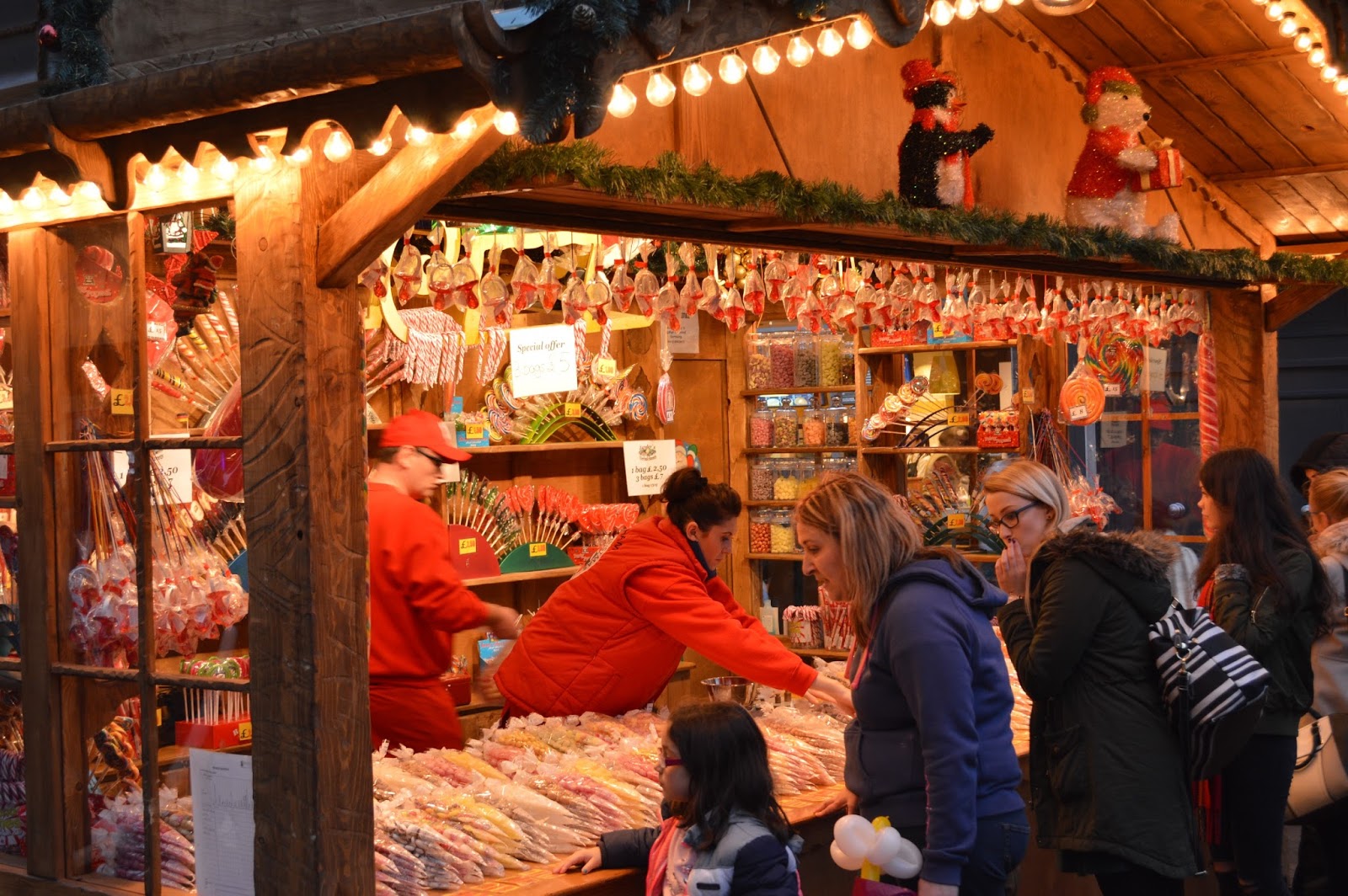
Originally the plan was to cross over to mainland Europe and check out a Christmas market in France; however, with recent events happening in France, it was decided to stay closer to home. Several friends and I drove to Birmingham to enjoy it's Frankfurt (German) Christmas market, Frankfurter Weihnachtsmarkt. To get the most out of our trip, we opted to spend the night and check out Stafford-Upon-Avon the following day.
We made it to Birmingham in good time and with only minor detours due to construction or a tricky roundabout, ate lunch, checked into our hotel, and then the fun began! We decided to take the public bus transport to the city center. It was our first time navigating the bus system, and I for one think we did amazing! I mean, we did successfully make it to the city center and get off the bus. From the bus stop, it was a short walk to the Christmas market.
In addition to the various market stalls, there were also several street performers. One in particular was quite entertaining, a man dressed (and painted) in all white with wings and blacked out eyes. He was quite creepy and stared after one of our group members albeit, she was completely freaking over him which only encouraged the performer. Shortly after the creepy angel, we toasted with a rather belligerent man enjoying the abundance of bier (beer) offered. It was a fun start to our afternoon/evening of fun!
There were many stalls of food, drinks, Christmas items, and other items. Since it was a German market, I was hoping to find a Weihnachtspyramide (Christmas Pyramid). Not only did I get the pyramid, I also bought a Nutcracker too! As for the food and drink stalls, well, I was like a kid in a candy store! There was the traditional German Stollen, red and white sausages, speculaas, and so much more! I was ecstatic to find poppy seed roll! My friends didn't seem to quite enjoy it as much as I did, but that just meant more for me! I also had some apfelwein (apple wine) which was nice and warm and tasted just yummy!
And what would a Christmas market trip be without some outdoor ice skating and a ride on the Big Wheel?! One of my friends hadn't been ice skating before, and it's been a while since the few times I have been. While ice skating could have just been a disaster (especially since it was a warm-ish day and the ice was slightly melted, leaving a thin layer of water on top), it was so much fun! Luckily, I did not fall once while trying to avoid the little kiddos that were going around with their helper penguins..
The next morning, after a very slow start (maybe due to a little too much fun the night before), we set off for Stafford-Upon-Avon. We found a small market that we browsed, then had lunch, and just walked around the city centre. The plan was to visit Shakespeare's home, but we decided there was just too much to see in a day and we needed to come back when we had more time. You can bet there will be a trip back in the near future, but for now, I'll leave you with a teaser..
This is where I will leave you! Have a wonderful Christmas and a Happy New Year!
Auf Wiedersehen! Tshüss!
Subscribe to:
Posts (Atom)